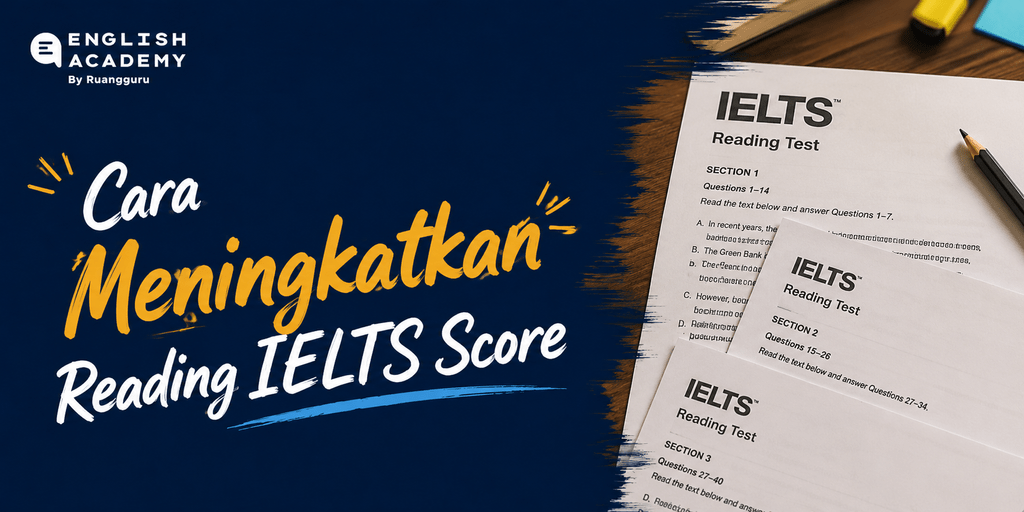
Cara Meningkatkan Reading IELTS Score
Buat kamu yang ingin meraih skor IELTS reading yang tinggi, yuk simak beberapa tips mengerjakan berikut ini!
—
Kemampuan membaca jadi salah satu skill yang diuji dalam tes IELTS. Di bagian ini, kamu akan membaca berbagai jenis teks berbahasa Inggris, seperti artikel informatif, hasil penelitian, dan opini dengan tingkat kesulitan yang berbeda-beda.
Buat banyak peserta, reading IELTS test sering dianggap cukup menantang. Soalnya bukan cuma karena teksnya panjang, tapi juga jumlah pertanyaannya banyak, sementara waktu yang diberikan terbatas. Jadi, selain harus paham isi bacaan, kamu juga dituntut bisa mengatur waktu dengan baik.
Kalau masih bingung harus mulai belajar dari mana, tenang aja. Di artikel ini, kita bakal bahas apa itu IELTS reading, sistem band score yang digunakan, contoh soal, dan tips yang bisa membantu kamu meningkatkan IELTS reading score. Yuk, simak sampai selesai!
Apa Itu Tes Reading IELTS?
IELTS reading adalah salah satu dari empat bagian dalam tes IELTS selain Listening, Writing, dan Speaking. Tes ini dirancang untuk mengukur kemampuan memahami informasi tertulis dalam bahasa Inggris, termasuk menemukan ide utama, menganalisis informasi, memahami opini penulis, serta menarik kesimpulan berdasarkan isi bacaan.
IELTS reading test dilakukan setelah listening test selesai. Tes ini berdurasi selama 60 menit, terdiri dari tiga section dan 40 soal. Kamu perlu membaca dengan cepat supaya waktu yang disediakan dalam tes dapat digunakan dengan maksimal.
Pada tes IELTS reading, kamu bisa memilih salah satu di antara dua jenis modul, yaitu academic dan general training. Tes ini juga bisa dikerjakan secara tertulis (IELTS Paper-based) atau menggunakan komputer (IELTS Computer-delivered).
IELTS Reading Test Module Academic
Dalam academic reading, terdapat tiga teks panjang yang mencakup teks deskripsi dan faktual, serta diskursif dan analitis. Teks yang tertera dalam academic reading biasanya diambil dari buku, jurnal, majalah, dan surat kabar.
IELTS Reading Test Module General Training
Kalau dalam general training, teks yang diujikan diambil dari pengumuman, buku, majalah, brosur, panduan, iklan, informasi layanan publik, company handbook, dan artikel yang membahas kehidupan sosial.
Meskipun tema bacaannya berbeda dengan academic training, peserta tetap dituntut memahami informasi secara akurat dalam waktu yang terbatas. Seluruh soal harus diselesaikan dalam waktu 60 menit karena tidak ada tambahan waktu untuk memindahkan jawaban ke lembar jawaban.
Baca Juga: IELTS Scoring System dan Band Scores pada IELTS
IELTS adalah tes bahasa Inggris yang tergolong sulit dan membutuhkan persiapan yang panjang dan matang untuk mendapatkan hasil terbaik. Mari persiapkan tes IELTS-mu bersama English Academy IELTS! Pembelajarannya spesifik dan banyak latihan menggunakan soal-soal IELTS. Pelajari selengkapnya dengan klik banner ini!

Jenis Pertanyaan dalam IELTS Reading
Nah, secara tipe soal di academic dan general training pada reading test itu sama. Terdapat 11 jenis pertanyaan yang biasanya diujikan, antara lain:
- Multiple choice (pilihan ganda)
- Isian True/False/Not Given terhadap informasi pada bacaan
- Isian True/False/Not Given terhadap pandangan penulis pada bacaan
- Mencocokkan informasi pada bacaan (matching information)
- Mencocokkan judul/heading (matching headings)
- Mencocokkan kalimat (matching sentence endings)
- Mencocokkan bacaan (matching features)
- Melengkapi kalimat
- Mengisi formulir/pesan/tabel/bagan/ringkasan (form/note/table/flow chart/summary completion)
- Memberi label pada bagan (plan/map/diagram labeling)
- Menjawab pertanyaan singkat (short-answer questions)
IELTS Scoring System
IELTS menggunakan sistem penilaian yang disebut band score, dengan skala mulai dari 0-9. Pada bagian ini, reading IELTS scoring dihitung berdasarkan jumlah jawaban benar dari total 40 soal. Setiap jawaban benar bernilai satu poin, kemudian total skor tersebut dikonversi menjadi reading IELTS band score sesuai standar penilaian IELTS. Semakin banyak jawaban yang benar, semakin tinggi band score yang akan diperoleh.
Perlu diketahui kalau konversi reading IELTS score academic dan general training berbeda. Hal ini karena tingkat kesulitan bacaan pada kedua jenis tes tidak sama. Jadi, jumlah jawaban benar yang dibutuhkan untuk mencapai band score tertentu juga berbeda.
Number of correct answers (IELTS Academic)
Number of correct answers (IELTS General Training )
Band Score
40-39
40
9
38-37
39
8.5
36-35
37-38
8
34-33
36
7.5
32-30
34-35
7
29-27
32-33
6.5
26-23
30-31
6
22-19
27-29
5.5
18-15
23-26
5
14-13
19-22
4.5
12-10
15-18
4
9-8
12-14
3.5
7-6
9-11
3
5-4
6-8
2.5
Contoh Soal IELTS Reading
Bagian reading pada IELTS menguji kemampuan memahami informasi, menemukan ide utama, mengidentifikasi detail, dan menarik kesimpulan dari sebuah bacaan. Berikut beberapa contoh soal yang paling sering muncul beserta pembahasannya.
Multiple Choice
Pada tipe soal ini, kamu diminta memilih satu jawaban yang paling tepat dari empat pilihan (A, B, C, atau D).
Contoh Soal
Sample Academic Reading Multiple Choice (one answer)
© The Economist Newspaper Limited, London, 1999
The general assumption is that older workers are paid more in spite of, rather than because of, their productivity. That might partly explain why, when employers are under pressure to cut costs, they persuade a 55-year old to take early retirement. Take away seniority-based pay scales, and older workers may become a much more attractive employment proposition. But most employers and many workers are uncomfortable with the idea of reducing someone’s pay in later life – although manual workers on piece-rates often earn less as they get older. So retaining the services of older workers may mean employing them in different ways.
One innovation was devised by IBM Belgium. Faced with the need to cut staff costs, and having decided to concentrate cuts on 55 to 60-year olds, IBM set up a separate company called Skill Team, which re-employed any of the early retired who wanted to go on working up to the age of 60. An employee who joined Skill Team at the age of 55 on a five-year contract would work for 58% of his time, over the full period, for 88% of his last IBM salary. The company offered services to IBM, thus allowing it to retain access to some of the intellectual capital it would otherwise have lost.
The best way to tempt the old to go on working may be to build on such ‘bridge’ jobs: parttime or temporary employment that creates a more gradual transition from full-time work to retirement. Studies have found that, in the United States, nearly half of all men and women who had been in full-time jobs in middle age moved into such ‘bridge’ jobs at the end of their working lives. In general, it is the best-paid and worst-paid who carry on working. There seem to be two very different types of bridge job-holder – those who continue working because they have to and those who continue working because they want to, even though they could afford to retire.
If the job market grows more flexible, the old may find more jobs that suit them. Often, they will be self-employed. Sometimes, they may start their own businesses: a study by David Storey of Warwick University found that in Britain 70% of businesses started by people over 55 survived, compared with an overall national average of only 19%. But whatever pattern of employment they choose, in the coming years the skills of these ‘grey workers’ will have to be increasingly acknowledged and rewarded.
Questions 1-4
Choose the correct letter, A, B, C or D.
Write the correct letter in boxes 1-4 on your answer sheet.
1. In paragraph one, the writer suggests that companies could consider
a. abolishing pay schemes that are based on age.
b. avoiding pay that is based on piece-rates.
c. increasing pay for older workers.
d. equipping older workers with new skills.
2. Skill Team is an example of a company which
offers older workers increases in salary.
allows people to continue working for as long as they want.
allows the expertise of older workers to be put to use.
treats older and younger workers equally.
3. According to the writer, ‘bridge’ jobs
a. tend to attract people in middle-salary ranges.
b. are better paid than some full-time jobs.
c. originated in the United States.
d. appeal to distinct groups of older workers.
4. David Storey’s study found that
a. people demand more from their work as they get older.
b. older people are good at running their own businesses.
c. an increasing number of old people are self-employed.
d. few young people have their own businesses.
Pembahasan
1. Jawaban: A
Pada paragraf pertama terdapat kalimat “Take away seniority-based pay scales, and older workers may become a much more attractive employment proposition.”
Kalimat tersebut berarti perusahaan dapat mempertimbangkan menghapus sistem gaji yang didasarkan pada senioritas atau usia, sehingga pekerja yang lebih tua menjadi lebih menarik untuk dipertahankan.
Pilihan lain tidak sesuai karena:
- B hanya membahas sistem upah borongan (piece-rates), bukan ide utama.
- C tidak pernah disebutkan bahwa gaji harus dinaikkan.
- D tidak ada pembahasan mengenai pelatihan keterampilan baru.
2. Jawaban: C
Pada paragraf kedua dijelaskan bahwa IBM membentuk Skill Team agar perusahaan tetap dapat memanfaatkan pengalaman dan pengetahuan pekerja senior.
Kata kuncinya adalah “…retain access to some of the intellectual capital…” (perusahaan masih dapat menggunakan keahlian para pekerja berpengalaman.)
3. Jawaban: D
Pada paragraf ketiga tertulis “There seem to be two very different types of bridge job-holder…”
Jadi, pekerjaan jenis ini menarik dua kelompok orang yang berbeda, yaitu mereka yang harus tetap bekerja karena kebutuhan finansial dan mereka yang tetap bekerja karena memang ingin.
4. Jawaban: B
Dalam paragraf terakhir disebutkan kalau “70% of businesses started by people over 55 survived…”
Hal ini menunjukkan bahwa orang yang berusia di atas 55 tahun memiliki tingkat keberhasilan yang tinggi dalam menjalankan bisnis.
True/False/Not Given Questions
Banyak peserta IELTS kesulitan membedakan FALSE dan NOT GIVEN. Perlu diingat, jika informasi tidak tersedia di teks, jangan berasumsi ya.
Contoh Soal
Sample Academic Reading Identifying Information (True/False/Not Given)
[Note: This is an extract from a Part 1 text about the scientist Marie Curie.]
Adapted with permission from Encyclopaedia Britannica, © 2007 by Encyclopaedia Britannica, Inc.
The Life and Work of Marie Curie
Marie Curie is probably the most famous woman scientist who has ever lived. Born Maria Sklodowska in Poland in 1867, she is famous for her work on radioactivity, and was twice a winner of the Nobel Prize. With her husband, Pierre Curie, and Henri Becquerel, she was awarded the 1903 Nobel Prize for Physics, and was then sole winner of the 1911 Nobel Prize for Chemistry. She was the first woman to win a Nobel Prize.
From childhood, Marie was remarkable for her prodigious memory, and at the age of 16 won a gold medal on completion of her secondary education. Because her father lost his savings through bad investment, she then had to take work as a teacher. From her earnings she was able to finance her sister Bronia’s medical studies in Paris, on the understanding that Bronia would, in turn, later help her to get an education.
In 1891 this promise was fulfilled and Marie went to Paris and began to study at the Sorbonne (the University of Paris). She often worked far into the night and lived on little more than bread and butter and tea. She came first in the examination in the physical sciences in 1893, and in 1894 was placed second in the examination in mathematical sciences. It was not until the spring of that year that she was introduced to Pierre Curie.
Questions 1-3
Do the following statements agree with the information given in Reading Passage 1?
In boxes 1-3 on your answer sheet, write
TRUE: if the statement agrees with the information
FALSE: if the statement contradicts the information
NOT GIVEN: if there is no information on this
1. Marie Curie’s husband was a joint winner of both Marie’s Nobel Prizes.
2. Marie became interested in science when she was a child.
3. Marie was able to attend the Sorbonne because of her sister’s financial contribution.
Pembahasan
1. Jawaban: FALSE
Pierre Curie memang memenangkan Nobel Fisika bersama Marie pada tahun 1903. Namun Nobel Kimia tahun 1911 hanya diterima oleh Marie Curie seorang diri. Karena informasi pada soal bertentangan dengan teks, jawabannya FALSE.
2. Jawaban: NOT GIVEN
Teks hanya menyebutkan bahwa Marie memiliki daya ingat yang luar biasa saat kecil. Tidak ada informasi mengenai kapan ia mulai tertarik pada ilmu pengetahuan. Karena tidak disebutkan, jawabannya NOT GIVEN.
3. Jawaban: TRUE
Teks menjelaskan bahwa Marie membiayai kuliah saudara perempuannya terlebih dahulu. Sebagai balasannya, sang saudara membantu Marie memperoleh pendidikan di Paris. Pernyataan tersebut sesuai dengan isi bacaan sehingga jawabannya TRUE.
Baca Juga: Tips Mengerjakan IELTS Listening Section
Matching Headings
Pada tipe soal ini, kamu diminta mencocokkan setiap paragraf dengan judul (heading) yang paling sesuai. Perlu diketahui kalau pada IELTS, satu bacaan biasanya dibagi menjadi beberapa bagian yang diberi label A, B, C, D, E, dan seterusnya. Setiap section terdiri dari satu atau beberapa paragraf yang membahas satu ide utama. Tugasmu adalah memilih heading yang paling menggambarkan isi utama dari setiap section.
Contoh Soal
Sample Academic Reading Matching Headings
© 2000 The Atlantic Media Co., as first published in The Atlantic Magazine. All rights reserved. Distributed by Tribune Content Agency.
Questions 1-4
Reading Passage 1 has five sections, A-E.
Choose the correct heading for each section from the list of headings below.
Write the correct number, i-viii, in boxes 1-4 on your answer sheet.
List of Headings
- Dramatic effects can result from small changes in traffic just as in nature
- How a maths experiment actually reduced traffic congestion
- How a concept from one field of study was applied in another
- A lack of investment in driver training
- Areas of doubt and disagreement between experts
- How different countries have dealt with traffic congestion
- The impact of driver behaviour on traffic speed
- A proposal to take control away from the driver
1. Section A
Example: Section B i
2. Section C
3. Section D
4. Section E
The Physics of Traffic Behavior
A. Some years ago, when several theoretical physicists, principally Dirk Helbing and Boris Kerner of Stuttgart, Germany, began publishing papers on traffic flow in publications normally read by traffic engineers, they were clearly working outside their usual sphere of investigation. They had noticed that if they simulated the movement of vehicles on a highway, using the equations that describe how the molecules of a gas move, some very strange results emerged. Of course, vehicles do not behave exactly like gas molecules: for example, drivers try to avoid collisions by slowing down when they get too near another vehicle, whereas gas molecules have no such concern. However, the physicists modified the equations to take the differences into account and the overall description of traffic as a flowing gas has proved to be a very good one; the moving-gas model of traffic reproduces many phenomena seen in real-world traffic.
The strangest thing that came out of these equations, however, was the implication that congestion can arise completely spontaneously; no external causes are necessary. Vehicles can be flowing freely along, at a density still well below what the road can handle, and then suddenly gel into a slow-moving ooze. Under the right conditions a brief and local fluctuation in the speed or the distance between vehicles is all it takes to trigger a system-wide breakdown that persists for hours. In fact, the physicists’ analysis suggested such spontaneous breakdowns in traffic flow probably occur quite frequently on highways.
B. Though a decidedly unsettling discovery, this showed striking similarities to the phenomena popularized as ‘chaos theory’. This theory has arisen from the understanding that in any complex interacting system which is made of many parts, each part affects the others. Consequently, tiny variations in one part of a complex system can grow in huge but unpredictable ways. This type of dramatic change from one state to another is similar to what happens when a chemical substance changes from a vapor to a liquid. It often happens that water in a cloud remains as a gas even after its temperature and density have reached the point where it could condense into water droplets. However, if the vapor encounters a solid surface, even something as small as a speck of dust, condensation can take place and the transition from vapor to liquid finally occurs. Helbing and Kerner see traffic as a complex interacting system. They found that a small fluctuation in traffic density can act as the ‘speck of dust’ causing a sudden change from freely moving traffic to synchronized traffic, when vehicles in all lanes abruptly slow down and start moving at the same speed, making passing impossible.
C. The physicists have challenged proposals to set a maximum capacity for vehicles on highways. They argue that it may not be enough simply to limit the rate at which vehicles are allowed to enter a highway, rather, it may be necessary to time each vehicle’s entry onto a highway precisely to coincide with a temporary drop in the density of vehicles along the road. The aim of doing this would be to smooth out any possible fluctuations in the road conditions that can trigger a change in traffic behavior and result in congestion. They further suggest that preventing breakdowns in the flow of traffic could ultimately require implementing the radical idea that has been suggested from time to time: directly regulating the speed and spacing of individual cars along a highway with central computers and sensors that communicate with each car’s engine and brake controls.
D. However, research into traffic control is generally centered in civil engineering departments and here the theories of the physicists have been greeted with some skepticism. Civil engineers favor a practical approach to problems and believe traffic congestion is the result of poor road construction (two lanes becoming one lane or dangerous curves), which constricts the flow of traffic. Engineers questioned how well the physicists’ theoretical results relate to traffic in the real world. Indeed, some engineering researchers questioned whether elaborate chaos-theory interpretations are needed at all, since at least some of the traffic phenomena the physicists’ theories predicted seemed to be similar to observations that had been appearing in traffic engineering literature under other names for years; observations which had straightforward cause-and-effect explanations.
E. James Banks, a professor of civil and environmental engineering at San Diego State University in the US, suggested that a sudden slowdown in traffic may have less to do with chaos theory than with driver psychology. As traffic gets heavier and the passing lane gets more crowded, aggressive drivers move to other lanes to try to pass, which also tends to even out the speed between lanes. He also felt that another leveling force is that when a driver in a fast lane brakes a little to maintain a safe distance between vehicles, the shock wave travels back much more rapidly than it would in the other slower lanes, because each following driver has to react more quickly. Consequently, as a road becomes congested, the faster moving traffic is the first to slow down.
Pembahasan
1. Section A: iii. How a concept from one field of study was applied in another
Section A membahas bagaimana konsep fisika, yaitu pergerakan molekul gas, diterapkan untuk menjelaskan perilaku lalu lintas. Ide utamanya adalah penerapan konsep dari satu bidang ilmu ke bidang lain.
2. Section B: i. Dramatic effects can result from small changes in traffic just as in nature
Section B menjelaskan jika perubahan kecil dalam kepadatan kendaraan dapat memicu kemacetan besar. Penjelasan ini dikaitkan dengan konsep chaos theory di alam.
3. Section C: viii. A proposal to take control away from the driver
Section C berisi usulan agar kecepatan dan jarak antar kendaraan diatur oleh komputer dan sensor, bukan sepenuhnya oleh pengemudi.
4. Section D: v. Areas of doubt and disagreement between experts
Section D menjelaskan adanya perbedaan pendapat antara fisikawan dan insinyur sipil mengenai penyebab kemacetan serta relevansi teori yang digunakan.
5. Section E: vii. The impact of driver behaviour on traffic speed
Section E membahas bagaimana perilaku pengemudi, seperti berpindah jalur atau mengerem, memengaruhi kecepatan lalu lintas dan menyebabkan kemacetan.
Baca Juga: Contoh Soal IELTS Reading Section dan Pembahasannya
Selain program IELTS, English Academy punya banya program belajar lainnya yang bisa disesuaikan dengan kebutuhan dan level kemampuanmu. Yuk, temukan program belajar yang paling cocok untuk kamu di English Academy. Klik banner di bawah untuk mulai perjalanan belajarmu!

Tips Meningkatkan Skor IELTS Reading
Meningkatkan skor IELTS reading membutuhkan latihan yang konsisten dan strategi yang tepat. Berikut beberapa tips IELTS reading yang dapat kamu terapkan selama masa persiapan.
1. Biasakan Membaca Teks Berbahasa Inggris
Semakin sering membaca artikel berbahasa Inggris, semakin mudah kamu memahami struktur kalimat, kosakata, dan cara penulis menyampaikan informasi.
Pilih bacaan dengan topik yang beragam, misalnya sains, kesehatan, lingkungan, sejarah, bisnis, dan teknologi. Kebiasaan ini juga membantu memperluas kosakata yang sering muncul dalam IELTS reading.
2. Pelajari Teknik Skimming dan Scanning
Dua teknik membaca ini sangat membantu ketika waktu pengerjaan terbatas.
- Skimming digunakan untuk menemukan gambaran umum isi bacaan dengan membaca cepat.
- Scanning digunakan untuk mencari informasi tertentu, seperti nama, angka, tanggal, atau kata kunci.
Dengan menguasai kedua teknik tersebut, kamu tidak perlu membaca seluruh teks secara perlahan setiap kali mencari jawaban.
3. Perbanyak Kosakata Akademik
Banyak bacaan IELTS menggunakan kosakata akademik maupun sinonim.
Saat menemukan kata baru, catat beserta artinya, contoh kalimat, dan beberapa sinonim yang memiliki makna serupa. Cara ini membantu kamu mengenali informasi yang sebenarnya ditulis dengan pilihan kata berbeda pada soal.
Baca Juga: Tips Menghadapi IELTS Reading Test
4. Jangan Menghabiskan Terlalu Banyak Waktu pada Satu Soal
Salah satu kesalahan yang sering terjadi adalah terlalu lama mencari jawaban untuk satu pertanyaan.
Jika menemukan soal yang sulit, lanjutkan ke soal berikutnya terlebih dahulu. Setelah seluruh soal selesai dikerjakan, gunakan sisa waktu untuk kembali memeriksa bagian yang masih meragukan.
5. Pahami Perbedaan true, false, dan not given
Banyak peserta kehilangan poin pada tipe soal ini karena kurang memahami perbedaannya.
- True berarti informasi pada soal sesuai dengan isi bacaan.
- False berarti informasi pada soal bertentangan dengan isi bacaan.
- Not Given berarti informasi tersebut sama sekali tidak disebutkan dalam teks.
Fokuslah pada informasi yang benar-benar tertulis. Hindari membuat asumsi berdasarkan pengetahuan di luar bacaan.
6. Latihan dengan Simulasi Waktu yang Sebenarnya
Karena durasi IELTS reading hanya 60 menit, biasakan mengerjakan latihan menggunakan batas waktu yang sama.
Latihan semacam ini membantu kamu mengatur kecepatan membaca, menentukan prioritas soal, serta mengurangi rasa panik ketika mengikuti ujian yang sebenarnya.
7. Evaluasi Kesalahan Setelah Berlatih
Setelah menyelesaikan latihan, jangan langsung melihat skor. Cari tahu alasan setiap jawaban yang salah. Apakah penyebabnya karena kurang teliti, salah memahami instruksi, kurang kosakata, atau terburu-buru saat membaca.
Evaluasi secara rutin membantu kamu mengetahui bagian mana yang masih perlu ditingkatkan.
8. Gunakan Sumber Belajar yang Kredibel
Berlatih menggunakan materi dari sumber terpercaya membuatmu lebih familiar dengan format soal IELTS yang sebenarnya.
Kamu dapat memanfaatkan latihan dari situs resmi IELTS, IELTS Liz, ApplyBoard, dan platform belajar bahasa Inggris yang menyediakan pembahasan lengkap mengenai strategi Reading.
—
Nah, itulah beberapa contoh soal yang sering muncul pada IELTS reading beserta tips mengerjakannya. Jangan khawatir kalau di awal masih terasa sulit. Semakin sering berlatih dan membiasakan diri membaca teks berbahasa Inggris, kamu akan semakin mudah memahami pola soal dan menemukan jawaban dengan lebih cepat.
Kalau targetmu adalah mendapatkan skor IELTS yang optimal, tentu persiapannya juga perlu lebih matang ya. Belajar bareng instruktur yang berpengalaman bisa membantumu memahami strategi mengerjakan soal lho.
Yuk, mulai persiapan IELTS-mu bersama English Academy! Kamu juga bisa mencoba Free Placement Test untuk mengetahui kemampuan bahasa Inggrismu saat ini. Langsung saja klik banner ini, ya!

Reference:
ApplyBoard Team. IELTS Reading Preparation: Top 10 Tips to Increase Your Score. Diakses 22 Juni 2026, dari https://www.applyboard.com/blog/ielts-reading-10-study-tips-to-help-increase-your-score.
Liz. IELTS Reading Tips: How can I improve my score. Diakses 22 Juni 2026, dari https://ieltsliz.com/ielts-reading-tips-how-can-i-improve-my-score/.
https://ielts.idp.com/uae/results/scores/reading?gclsrc=aw.ds&gad_source=1&gad_campaignid=20980249589&gbraid=0AAAAADPFTOQOS7GccWmDEKdCUFrIca4f3&gclid=Cj0KCQjwr4jSBhCSARIsAOX1E-INoTvOumnltg-G944DS5Xm2XNrc2QUSLRp1rkFxu7zNFT2xWEh1bAaAtg-EALw_wcB
Buat kamu yang ingin meraih skor IELTS reading yang tinggi, yuk simak beberapa tips mengerjakan berikut ini!
—
Kemampuan membaca jadi salah satu skill yang diuji dalam tes IELTS. Di bagian ini, kamu akan membaca berbagai jenis teks berbahasa Inggris, seperti artikel informatif, hasil penelitian, dan opini dengan tingkat kesulitan yang berbeda-beda.
Buat banyak peserta, reading IELTS test sering dianggap cukup menantang. Soalnya bukan cuma karena teksnya panjang, tapi juga jumlah pertanyaannya banyak, sementara waktu yang diberikan terbatas. Jadi, selain harus paham isi bacaan, kamu juga dituntut bisa mengatur waktu dengan baik.
Kalau masih bingung harus mulai belajar dari mana, tenang aja. Di artikel ini, kita bakal bahas apa itu IELTS reading, sistem band score yang digunakan, contoh soal, dan tips yang bisa membantu kamu meningkatkan IELTS reading score. Yuk, simak sampai selesai!
Apa Itu Tes Reading IELTS?
IELTS reading adalah salah satu dari empat bagian dalam tes IELTS selain Listening, Writing, dan Speaking. Tes ini dirancang untuk mengukur kemampuan memahami informasi tertulis dalam bahasa Inggris, termasuk menemukan ide utama, menganalisis informasi, memahami opini penulis, serta menarik kesimpulan berdasarkan isi bacaan.
IELTS reading test dilakukan setelah listening test selesai. Tes ini berdurasi selama 60 menit, terdiri dari tiga section dan 40 soal. Kamu perlu membaca dengan cepat supaya waktu yang disediakan dalam tes dapat digunakan dengan maksimal.
Pada tes IELTS reading, kamu bisa memilih salah satu di antara dua jenis modul, yaitu academic dan general training. Tes ini juga bisa dikerjakan secara tertulis (IELTS Paper-based) atau menggunakan komputer (IELTS Computer-delivered).
IELTS Reading Test Module Academic
Dalam academic reading, terdapat tiga teks panjang yang mencakup teks deskripsi dan faktual, serta diskursif dan analitis. Teks yang tertera dalam academic reading biasanya diambil dari buku, jurnal, majalah, dan surat kabar.
IELTS Reading Test Module General Training
Kalau dalam general training, teks yang diujikan diambil dari pengumuman, buku, majalah, brosur, panduan, iklan, informasi layanan publik, company handbook, dan artikel yang membahas kehidupan sosial.
Meskipun tema bacaannya berbeda dengan academic training, peserta tetap dituntut memahami informasi secara akurat dalam waktu yang terbatas. Seluruh soal harus diselesaikan dalam waktu 60 menit karena tidak ada tambahan waktu untuk memindahkan jawaban ke lembar jawaban.
Baca Juga: IELTS Scoring System dan Band Scores pada IELTS
IELTS adalah tes bahasa Inggris yang tergolong sulit dan membutuhkan persiapan yang panjang dan matang untuk mendapatkan hasil terbaik. Mari persiapkan tes IELTS-mu bersama English Academy IELTS! Pembelajarannya spesifik dan banyak latihan menggunakan soal-soal IELTS. Pelajari selengkapnya dengan klik banner ini!
Jenis Pertanyaan dalam IELTS Reading
Nah, secara tipe soal di academic dan general training pada reading test itu sama. Terdapat 11 jenis pertanyaan yang biasanya diujikan, antara lain:
- Multiple choice (pilihan ganda)
- Isian True/False/Not Given terhadap informasi pada bacaan
- Isian True/False/Not Given terhadap pandangan penulis pada bacaan
- Mencocokkan informasi pada bacaan (matching information)
- Mencocokkan judul/heading (matching headings)
- Mencocokkan kalimat (matching sentence endings)
- Mencocokkan bacaan (matching features)
- Melengkapi kalimat
- Mengisi formulir/pesan/tabel/bagan/ringkasan (form/note/table/flow chart/summary completion)
- Memberi label pada bagan (plan/map/diagram labeling)
- Menjawab pertanyaan singkat (short-answer questions)
IELTS Scoring System
IELTS menggunakan sistem penilaian yang disebut band score, dengan skala mulai dari 0-9. Pada bagian ini, reading IELTS scoring dihitung berdasarkan jumlah jawaban benar dari total 40 soal. Setiap jawaban benar bernilai satu poin, kemudian total skor tersebut dikonversi menjadi reading IELTS band score sesuai standar penilaian IELTS. Semakin banyak jawaban yang benar, semakin tinggi band score yang akan diperoleh.
Perlu diketahui kalau konversi reading IELTS score academic dan general training berbeda. Hal ini karena tingkat kesulitan bacaan pada kedua jenis tes tidak sama. Jadi, jumlah jawaban benar yang dibutuhkan untuk mencapai band score tertentu juga berbeda.
| Number of correct answers (IELTS Academic) | Number of correct answers (IELTS General Training ) | Band Score |
| 40-39 | 40 | 9 |
| 38-37 | 39 | 8.5 |
| 36-35 | 37-38 | 8 |
| 34-33 | 36 | 7.5 |
| 32-30 | 34-35 | 7 |
| 29-27 | 32-33 | 6.5 |
| 26-23 | 30-31 | 6 |
| 22-19 | 27-29 | 5.5 |
| 18-15 | 23-26 | 5 |
| 14-13 | 19-22 | 4.5 |
| 12-10 | 15-18 | 4 |
| 9-8 | 12-14 | 3.5 |
| 7-6 | 9-11 | 3 |
| 5-4 | 6-8 | 2.5 |
Contoh Soal IELTS Reading
Bagian reading pada IELTS menguji kemampuan memahami informasi, menemukan ide utama, mengidentifikasi detail, dan menarik kesimpulan dari sebuah bacaan. Berikut beberapa contoh soal yang paling sering muncul beserta pembahasannya.
Multiple Choice
Pada tipe soal ini, kamu diminta memilih satu jawaban yang paling tepat dari empat pilihan (A, B, C, atau D).
Contoh Soal
Sample Academic Reading Multiple Choice (one answer)
© The Economist Newspaper Limited, London, 1999
The general assumption is that older workers are paid more in spite of, rather than because of, their productivity. That might partly explain why, when employers are under pressure to cut costs, they persuade a 55-year old to take early retirement. Take away seniority-based pay scales, and older workers may become a much more attractive employment proposition. But most employers and many workers are uncomfortable with the idea of reducing someone’s pay in later life – although manual workers on piece-rates often earn less as they get older. So retaining the services of older workers may mean employing them in different ways.
One innovation was devised by IBM Belgium. Faced with the need to cut staff costs, and having decided to concentrate cuts on 55 to 60-year olds, IBM set up a separate company called Skill Team, which re-employed any of the early retired who wanted to go on working up to the age of 60. An employee who joined Skill Team at the age of 55 on a five-year contract would work for 58% of his time, over the full period, for 88% of his last IBM salary. The company offered services to IBM, thus allowing it to retain access to some of the intellectual capital it would otherwise have lost.
The best way to tempt the old to go on working may be to build on such ‘bridge’ jobs: parttime or temporary employment that creates a more gradual transition from full-time work to retirement. Studies have found that, in the United States, nearly half of all men and women who had been in full-time jobs in middle age moved into such ‘bridge’ jobs at the end of their working lives. In general, it is the best-paid and worst-paid who carry on working. There seem to be two very different types of bridge job-holder – those who continue working because they have to and those who continue working because they want to, even though they could afford to retire.
If the job market grows more flexible, the old may find more jobs that suit them. Often, they will be self-employed. Sometimes, they may start their own businesses: a study by David Storey of Warwick University found that in Britain 70% of businesses started by people over 55 survived, compared with an overall national average of only 19%. But whatever pattern of employment they choose, in the coming years the skills of these ‘grey workers’ will have to be increasingly acknowledged and rewarded.
Questions 1-4
Choose the correct letter, A, B, C or D.
Write the correct letter in boxes 1-4 on your answer sheet.
1. In paragraph one, the writer suggests that companies could consider
a. abolishing pay schemes that are based on age.
b. avoiding pay that is based on piece-rates.
c. increasing pay for older workers.
d. equipping older workers with new skills.
2. Skill Team is an example of a company which
offers older workers increases in salary.
allows people to continue working for as long as they want.
allows the expertise of older workers to be put to use.
treats older and younger workers equally.
3. According to the writer, ‘bridge’ jobs
a. tend to attract people in middle-salary ranges.
b. are better paid than some full-time jobs.
c. originated in the United States.
d. appeal to distinct groups of older workers.
4. David Storey’s study found that
a. people demand more from their work as they get older.
b. older people are good at running their own businesses.
c. an increasing number of old people are self-employed.
d. few young people have their own businesses.
Pembahasan
1. Jawaban: A
Pada paragraf pertama terdapat kalimat “Take away seniority-based pay scales, and older workers may become a much more attractive employment proposition.”
Kalimat tersebut berarti perusahaan dapat mempertimbangkan menghapus sistem gaji yang didasarkan pada senioritas atau usia, sehingga pekerja yang lebih tua menjadi lebih menarik untuk dipertahankan.
Pilihan lain tidak sesuai karena:
- B hanya membahas sistem upah borongan (piece-rates), bukan ide utama.
- C tidak pernah disebutkan bahwa gaji harus dinaikkan.
- D tidak ada pembahasan mengenai pelatihan keterampilan baru.
2. Jawaban: C
Pada paragraf kedua dijelaskan bahwa IBM membentuk Skill Team agar perusahaan tetap dapat memanfaatkan pengalaman dan pengetahuan pekerja senior.
Kata kuncinya adalah “…retain access to some of the intellectual capital…” (perusahaan masih dapat menggunakan keahlian para pekerja berpengalaman.)
3. Jawaban: D
Pada paragraf ketiga tertulis “There seem to be two very different types of bridge job-holder…”
Jadi, pekerjaan jenis ini menarik dua kelompok orang yang berbeda, yaitu mereka yang harus tetap bekerja karena kebutuhan finansial dan mereka yang tetap bekerja karena memang ingin.
4. Jawaban: B
Dalam paragraf terakhir disebutkan kalau “70% of businesses started by people over 55 survived…”
Hal ini menunjukkan bahwa orang yang berusia di atas 55 tahun memiliki tingkat keberhasilan yang tinggi dalam menjalankan bisnis.
True/False/Not Given Questions
Banyak peserta IELTS kesulitan membedakan FALSE dan NOT GIVEN. Perlu diingat, jika informasi tidak tersedia di teks, jangan berasumsi ya.
Contoh Soal
Sample Academic Reading Identifying Information (True/False/Not Given)
[Note: This is an extract from a Part 1 text about the scientist Marie Curie.]
Adapted with permission from Encyclopaedia Britannica, © 2007 by Encyclopaedia Britannica, Inc.
The Life and Work of Marie Curie
Marie Curie is probably the most famous woman scientist who has ever lived. Born Maria Sklodowska in Poland in 1867, she is famous for her work on radioactivity, and was twice a winner of the Nobel Prize. With her husband, Pierre Curie, and Henri Becquerel, she was awarded the 1903 Nobel Prize for Physics, and was then sole winner of the 1911 Nobel Prize for Chemistry. She was the first woman to win a Nobel Prize.
From childhood, Marie was remarkable for her prodigious memory, and at the age of 16 won a gold medal on completion of her secondary education. Because her father lost his savings through bad investment, she then had to take work as a teacher. From her earnings she was able to finance her sister Bronia’s medical studies in Paris, on the understanding that Bronia would, in turn, later help her to get an education.
In 1891 this promise was fulfilled and Marie went to Paris and began to study at the Sorbonne (the University of Paris). She often worked far into the night and lived on little more than bread and butter and tea. She came first in the examination in the physical sciences in 1893, and in 1894 was placed second in the examination in mathematical sciences. It was not until the spring of that year that she was introduced to Pierre Curie.
Questions 1-3
Do the following statements agree with the information given in Reading Passage 1?
In boxes 1-3 on your answer sheet, write
TRUE: if the statement agrees with the information
FALSE: if the statement contradicts the information
NOT GIVEN: if there is no information on this
1. Marie Curie’s husband was a joint winner of both Marie’s Nobel Prizes.
2. Marie became interested in science when she was a child.
3. Marie was able to attend the Sorbonne because of her sister’s financial contribution.
Pembahasan
1. Jawaban: FALSE
Pierre Curie memang memenangkan Nobel Fisika bersama Marie pada tahun 1903. Namun Nobel Kimia tahun 1911 hanya diterima oleh Marie Curie seorang diri. Karena informasi pada soal bertentangan dengan teks, jawabannya FALSE.
2. Jawaban: NOT GIVEN
Teks hanya menyebutkan bahwa Marie memiliki daya ingat yang luar biasa saat kecil. Tidak ada informasi mengenai kapan ia mulai tertarik pada ilmu pengetahuan. Karena tidak disebutkan, jawabannya NOT GIVEN.
3. Jawaban: TRUE
Teks menjelaskan bahwa Marie membiayai kuliah saudara perempuannya terlebih dahulu. Sebagai balasannya, sang saudara membantu Marie memperoleh pendidikan di Paris. Pernyataan tersebut sesuai dengan isi bacaan sehingga jawabannya TRUE.
Baca Juga: Tips Mengerjakan IELTS Listening Section
Matching Headings
Pada tipe soal ini, kamu diminta mencocokkan setiap paragraf dengan judul (heading) yang paling sesuai. Perlu diketahui kalau pada IELTS, satu bacaan biasanya dibagi menjadi beberapa bagian yang diberi label A, B, C, D, E, dan seterusnya. Setiap section terdiri dari satu atau beberapa paragraf yang membahas satu ide utama. Tugasmu adalah memilih heading yang paling menggambarkan isi utama dari setiap section.
Contoh Soal
Sample Academic Reading Matching Headings
© 2000 The Atlantic Media Co., as first published in The Atlantic Magazine. All rights reserved. Distributed by Tribune Content Agency.
Questions 1-4
Reading Passage 1 has five sections, A-E.
Choose the correct heading for each section from the list of headings below.
Write the correct number, i-viii, in boxes 1-4 on your answer sheet.
|
List of Headings
|
1. Section A
Example: Section B i
2. Section C
3. Section D
4. Section E
The Physics of Traffic Behavior
A. Some years ago, when several theoretical physicists, principally Dirk Helbing and Boris Kerner of Stuttgart, Germany, began publishing papers on traffic flow in publications normally read by traffic engineers, they were clearly working outside their usual sphere of investigation. They had noticed that if they simulated the movement of vehicles on a highway, using the equations that describe how the molecules of a gas move, some very strange results emerged. Of course, vehicles do not behave exactly like gas molecules: for example, drivers try to avoid collisions by slowing down when they get too near another vehicle, whereas gas molecules have no such concern. However, the physicists modified the equations to take the differences into account and the overall description of traffic as a flowing gas has proved to be a very good one; the moving-gas model of traffic reproduces many phenomena seen in real-world traffic.
The strangest thing that came out of these equations, however, was the implication that congestion can arise completely spontaneously; no external causes are necessary. Vehicles can be flowing freely along, at a density still well below what the road can handle, and then suddenly gel into a slow-moving ooze. Under the right conditions a brief and local fluctuation in the speed or the distance between vehicles is all it takes to trigger a system-wide breakdown that persists for hours. In fact, the physicists’ analysis suggested such spontaneous breakdowns in traffic flow probably occur quite frequently on highways.
B. Though a decidedly unsettling discovery, this showed striking similarities to the phenomena popularized as ‘chaos theory’. This theory has arisen from the understanding that in any complex interacting system which is made of many parts, each part affects the others. Consequently, tiny variations in one part of a complex system can grow in huge but unpredictable ways. This type of dramatic change from one state to another is similar to what happens when a chemical substance changes from a vapor to a liquid. It often happens that water in a cloud remains as a gas even after its temperature and density have reached the point where it could condense into water droplets. However, if the vapor encounters a solid surface, even something as small as a speck of dust, condensation can take place and the transition from vapor to liquid finally occurs. Helbing and Kerner see traffic as a complex interacting system. They found that a small fluctuation in traffic density can act as the ‘speck of dust’ causing a sudden change from freely moving traffic to synchronized traffic, when vehicles in all lanes abruptly slow down and start moving at the same speed, making passing impossible.
C. The physicists have challenged proposals to set a maximum capacity for vehicles on highways. They argue that it may not be enough simply to limit the rate at which vehicles are allowed to enter a highway, rather, it may be necessary to time each vehicle’s entry onto a highway precisely to coincide with a temporary drop in the density of vehicles along the road. The aim of doing this would be to smooth out any possible fluctuations in the road conditions that can trigger a change in traffic behavior and result in congestion. They further suggest that preventing breakdowns in the flow of traffic could ultimately require implementing the radical idea that has been suggested from time to time: directly regulating the speed and spacing of individual cars along a highway with central computers and sensors that communicate with each car’s engine and brake controls.
D. However, research into traffic control is generally centered in civil engineering departments and here the theories of the physicists have been greeted with some skepticism. Civil engineers favor a practical approach to problems and believe traffic congestion is the result of poor road construction (two lanes becoming one lane or dangerous curves), which constricts the flow of traffic. Engineers questioned how well the physicists’ theoretical results relate to traffic in the real world. Indeed, some engineering researchers questioned whether elaborate chaos-theory interpretations are needed at all, since at least some of the traffic phenomena the physicists’ theories predicted seemed to be similar to observations that had been appearing in traffic engineering literature under other names for years; observations which had straightforward cause-and-effect explanations.
E. James Banks, a professor of civil and environmental engineering at San Diego State University in the US, suggested that a sudden slowdown in traffic may have less to do with chaos theory than with driver psychology. As traffic gets heavier and the passing lane gets more crowded, aggressive drivers move to other lanes to try to pass, which also tends to even out the speed between lanes. He also felt that another leveling force is that when a driver in a fast lane brakes a little to maintain a safe distance between vehicles, the shock wave travels back much more rapidly than it would in the other slower lanes, because each following driver has to react more quickly. Consequently, as a road becomes congested, the faster moving traffic is the first to slow down.
Pembahasan
1. Section A: iii. How a concept from one field of study was applied in another
Section A membahas bagaimana konsep fisika, yaitu pergerakan molekul gas, diterapkan untuk menjelaskan perilaku lalu lintas. Ide utamanya adalah penerapan konsep dari satu bidang ilmu ke bidang lain.
2. Section B: i. Dramatic effects can result from small changes in traffic just as in nature
Section B menjelaskan jika perubahan kecil dalam kepadatan kendaraan dapat memicu kemacetan besar. Penjelasan ini dikaitkan dengan konsep chaos theory di alam.
3. Section C: viii. A proposal to take control away from the driver
Section C berisi usulan agar kecepatan dan jarak antar kendaraan diatur oleh komputer dan sensor, bukan sepenuhnya oleh pengemudi.
4. Section D: v. Areas of doubt and disagreement between experts
Section D menjelaskan adanya perbedaan pendapat antara fisikawan dan insinyur sipil mengenai penyebab kemacetan serta relevansi teori yang digunakan.
5. Section E: vii. The impact of driver behaviour on traffic speed
Section E membahas bagaimana perilaku pengemudi, seperti berpindah jalur atau mengerem, memengaruhi kecepatan lalu lintas dan menyebabkan kemacetan.
Baca Juga: Contoh Soal IELTS Reading Section dan Pembahasannya
Selain program IELTS, English Academy punya banya program belajar lainnya yang bisa disesuaikan dengan kebutuhan dan level kemampuanmu. Yuk, temukan program belajar yang paling cocok untuk kamu di English Academy. Klik banner di bawah untuk mulai perjalanan belajarmu!
Tips Meningkatkan Skor IELTS Reading
Meningkatkan skor IELTS reading membutuhkan latihan yang konsisten dan strategi yang tepat. Berikut beberapa tips IELTS reading yang dapat kamu terapkan selama masa persiapan.
1. Biasakan Membaca Teks Berbahasa Inggris
Semakin sering membaca artikel berbahasa Inggris, semakin mudah kamu memahami struktur kalimat, kosakata, dan cara penulis menyampaikan informasi.
Pilih bacaan dengan topik yang beragam, misalnya sains, kesehatan, lingkungan, sejarah, bisnis, dan teknologi. Kebiasaan ini juga membantu memperluas kosakata yang sering muncul dalam IELTS reading.
2. Pelajari Teknik Skimming dan Scanning
Dua teknik membaca ini sangat membantu ketika waktu pengerjaan terbatas.
- Skimming digunakan untuk menemukan gambaran umum isi bacaan dengan membaca cepat.
- Scanning digunakan untuk mencari informasi tertentu, seperti nama, angka, tanggal, atau kata kunci.
Dengan menguasai kedua teknik tersebut, kamu tidak perlu membaca seluruh teks secara perlahan setiap kali mencari jawaban.
3. Perbanyak Kosakata Akademik
Banyak bacaan IELTS menggunakan kosakata akademik maupun sinonim.
Saat menemukan kata baru, catat beserta artinya, contoh kalimat, dan beberapa sinonim yang memiliki makna serupa. Cara ini membantu kamu mengenali informasi yang sebenarnya ditulis dengan pilihan kata berbeda pada soal.
Baca Juga: Tips Menghadapi IELTS Reading Test
4. Jangan Menghabiskan Terlalu Banyak Waktu pada Satu Soal
Salah satu kesalahan yang sering terjadi adalah terlalu lama mencari jawaban untuk satu pertanyaan.
Jika menemukan soal yang sulit, lanjutkan ke soal berikutnya terlebih dahulu. Setelah seluruh soal selesai dikerjakan, gunakan sisa waktu untuk kembali memeriksa bagian yang masih meragukan.
5. Pahami Perbedaan true, false, dan not given
Banyak peserta kehilangan poin pada tipe soal ini karena kurang memahami perbedaannya.
- True berarti informasi pada soal sesuai dengan isi bacaan.
- False berarti informasi pada soal bertentangan dengan isi bacaan.
- Not Given berarti informasi tersebut sama sekali tidak disebutkan dalam teks.
Fokuslah pada informasi yang benar-benar tertulis. Hindari membuat asumsi berdasarkan pengetahuan di luar bacaan.
6. Latihan dengan Simulasi Waktu yang Sebenarnya
Karena durasi IELTS reading hanya 60 menit, biasakan mengerjakan latihan menggunakan batas waktu yang sama.
Latihan semacam ini membantu kamu mengatur kecepatan membaca, menentukan prioritas soal, serta mengurangi rasa panik ketika mengikuti ujian yang sebenarnya.
7. Evaluasi Kesalahan Setelah Berlatih
Setelah menyelesaikan latihan, jangan langsung melihat skor. Cari tahu alasan setiap jawaban yang salah. Apakah penyebabnya karena kurang teliti, salah memahami instruksi, kurang kosakata, atau terburu-buru saat membaca.
Evaluasi secara rutin membantu kamu mengetahui bagian mana yang masih perlu ditingkatkan.
8. Gunakan Sumber Belajar yang Kredibel
Berlatih menggunakan materi dari sumber terpercaya membuatmu lebih familiar dengan format soal IELTS yang sebenarnya.
Kamu dapat memanfaatkan latihan dari situs resmi IELTS, IELTS Liz, ApplyBoard, dan platform belajar bahasa Inggris yang menyediakan pembahasan lengkap mengenai strategi Reading.
—
Nah, itulah beberapa contoh soal yang sering muncul pada IELTS reading beserta tips mengerjakannya. Jangan khawatir kalau di awal masih terasa sulit. Semakin sering berlatih dan membiasakan diri membaca teks berbahasa Inggris, kamu akan semakin mudah memahami pola soal dan menemukan jawaban dengan lebih cepat.
Kalau targetmu adalah mendapatkan skor IELTS yang optimal, tentu persiapannya juga perlu lebih matang ya. Belajar bareng instruktur yang berpengalaman bisa membantumu memahami strategi mengerjakan soal lho.
Yuk, mulai persiapan IELTS-mu bersama English Academy! Kamu juga bisa mencoba Free Placement Test untuk mengetahui kemampuan bahasa Inggrismu saat ini. Langsung saja klik banner ini, ya!
Reference:
ApplyBoard Team. IELTS Reading Preparation: Top 10 Tips to Increase Your Score. Diakses 22 Juni 2026, dari https://www.applyboard.com/blog/ielts-reading-10-study-tips-to-help-increase-your-score.
Liz. IELTS Reading Tips: How can I improve my score. Diakses 22 Juni 2026, dari https://ieltsliz.com/ielts-reading-tips-how-can-i-improve-my-score/.
https://ielts.idp.com/uae/results/scores/reading?gclsrc=aw.ds&gad_source=1&gad_campaignid=20980249589&gbraid=0AAAAADPFTOQOS7GccWmDEKdCUFrIca4f3&gclid=Cj0KCQjwr4jSBhCSARIsAOX1E-INoTvOumnltg-G944DS5Xm2XNrc2QUSLRp1rkFxu7zNFT2xWEh1bAaAtg-EALw_wcB

Olivia Yunita
Bagikan artikel ini: